Transmission Warning Light in Car On? Causes, Symptoms & What To Do Right Now
That little gear light on your dashboard is your gearbox asking for help early. Here is what it means, the five causes we see most often in Dubai, and exactly what to do in the first ten minutes.
It usually happens at the worst possible moment. You are halfway across town, the traffic is moving, and a small orange symbol lights up on your dashboard that was not there this morning. For a lot of Dubai drivers, that is their first real introduction to their gearbox — and the first question is always the same one: can I keep driving, or am I about to do serious damage?
This guide answers that properly. What the transmission warning light actually means, the five causes we see most often at our Ras Al Khor workshop, and the simple steps to take in the first ten minutes so a small fault does not turn into a full gearbox rebuild.
What Does the Transmission Warning Light Look Like?
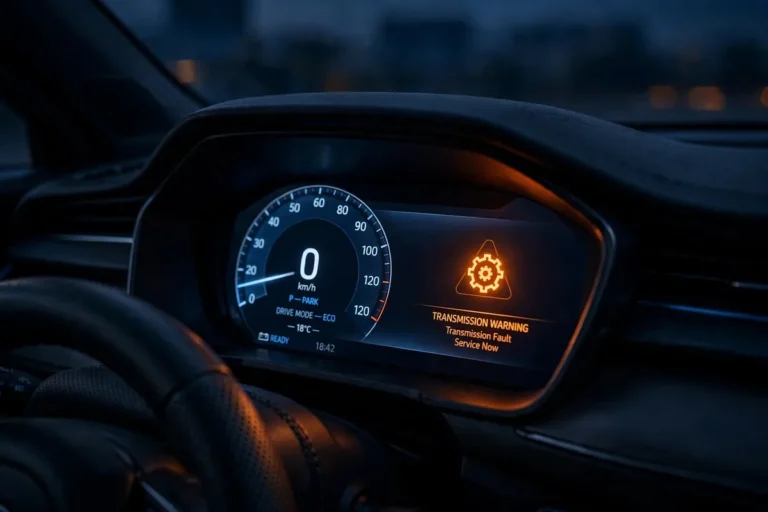
Unlike the engine light, which almost every driver knows, the transmission warning light changes from car to car. On many models it is a gear symbol, sometimes with an exclamation mark inside it. On others, there is no separate light at all — the car shows a message on the display instead, something like "Transmission fault," "Gearbox malfunction," or "Check transmission."
Some cars use the check-engine light for gearbox faults too, which is why a warning light on its own does not tell you the problem. It only tells you the car’s computer has spotted something it does not like — a sensor reading out of range, a temperature climbing too high, or a gear change that did not happen the way it should. The light is the start of the diagnosis, not the diagnosis itself.
The 5 Most Common Causes We See in Dubai
1. Low or old transmission fluid
This is the most common cause, and happily one of the cheapest to fix. Fluid is the lifeblood of an automatic gearbox — it creates the pressure that changes gears and keeps everything cool. When the level drops because of a small leak, or the fluid is simply old and burnt, pressure falls, changes get rough, and the warning light follows.
2. Overheating
Dubai heat is hard on gearboxes. Long summer drives, heavy traffic, and towing push transmission temperatures up, and hot fluid stops protecting the parts inside. Many modern cars switch the warning light on purely because the gearbox is too hot — and some will limit power until it cools down.
3. A failing sensor or solenoid
Your gearbox relies on speed sensors and small electric valves called solenoids to decide when and how to change gear. When one starts to fail, the computer sees gear changes happening at the wrong time — or not happening at all — and flags a fault. The gearbox itself may be mechanically fine.
4. Mechatronic or valve body problems
On modern gearboxes — DSG units in Audi and Volkswagen, and the 8-speed automatics in BMW, for example — an electronic control unit directs the fluid that makes the changes. When that unit or the valve body wears, you get harsh shifts, delays, and a warning light, even though the gears themselves are in good condition.
5. Slipping clutches inside the gearbox
This is the more serious end of the list. If the internal clutches are worn, the gearbox starts to slip — the engine revs rise but the car does not pick up speed the way it should. Left alone, slipping generates heat and debris, and a repairable fault becomes an overhaul.
Can You Drive With the Transmission Warning Light On?
It depends on how the car feels, and this is the honest answer we give our own customers:
- Light on, car driving normally? You can usually drive carefully to a workshop the same day. Keep speeds moderate, avoid hard acceleration, and do not ignore it until next week.
- Light on plus jerking, slipping, or strange noises? Get the car checked that day. Every kilometre with a slipping or jerking gearbox can add wear.
- Red warning, flashing light, or the car stuck in one gear (limp mode)? Stop driving it. Limp mode is the car protecting itself — it locks into a single gear so you can move out of danger, not so you can finish your journey. Driving on risks turning a sensor or fluid problem into internal damage. Call for recovery, or call us and we will tell you honestly whether it is safe to come in.
One more thing worth knowing: turning the engine off and on again sometimes makes the light disappear. That does not mean the fault fixed itself. The code stays stored in the car’s computer, and a proper scan will still find it.
How We Diagnose a Transmission Warning Light in Ras Al Khor
When a car comes to us with a warning light on, we do not guess and we do not start by stripping the gearbox. The process is methodical:
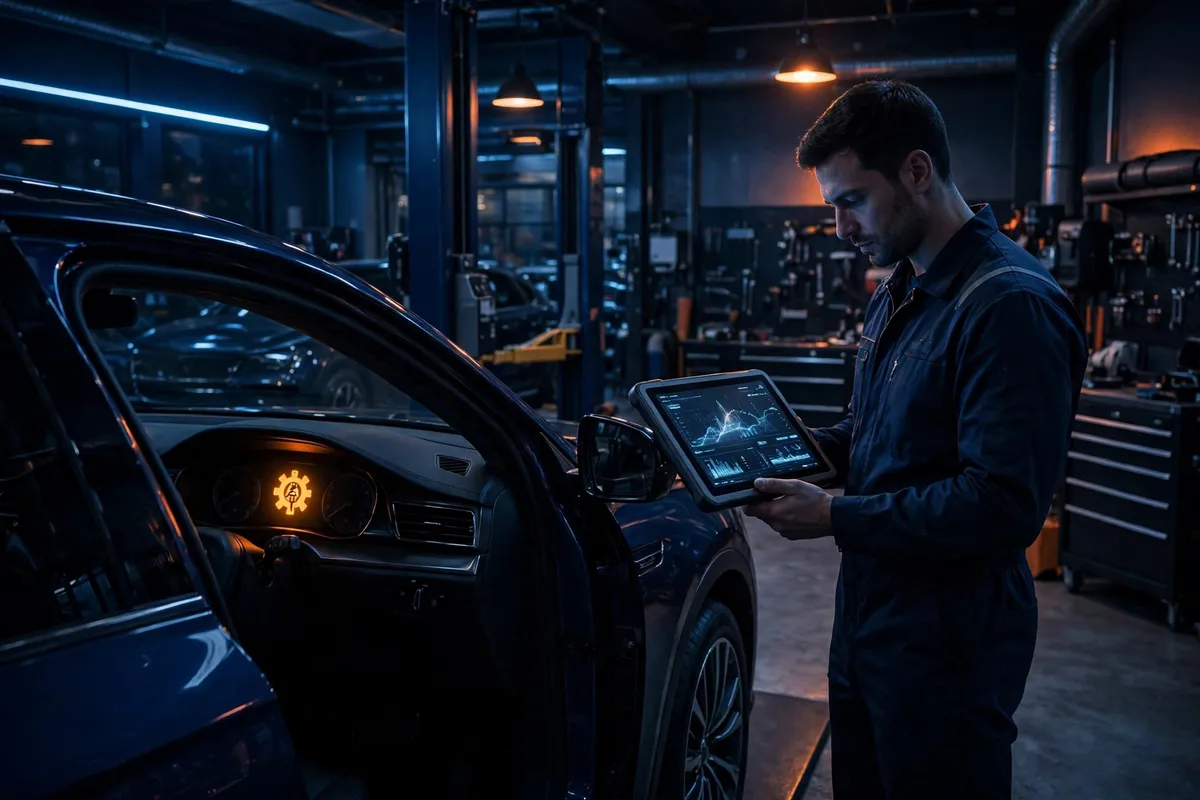
- Computer scan first. We read the fault codes stored in the transmission control unit. The codes point us to the system that triggered the light — temperature, pressure, a sensor, or a specific gear.
- Fluid check. Level, colour, and smell tell us a lot. Healthy fluid is red and clean; dark, burnt-smelling fluid points to overheating or internal wear.
- Live road test. We drive the car with the scanner connected and watch the gear changes happen in real time, so we see exactly where the shift goes wrong.
- Honest report before any work. You get told what the fault is, what it takes to fix it, and what it costs — before we touch anything. Many warning lights end with a fluid change, a sensor, or a solenoid, not a rebuild.
That order matters. A gearbox issue fix that starts with the code and the evidence is almost always cheaper than one that starts with a spanner.
Frequently Asked Questions
What does the transmission warning light mean?
It means the car’s computer has detected a fault in the gearbox system — anything from low fluid or overheating to a failing sensor or internal wear. The light alone cannot say which one; a diagnostic scan reads the stored fault code and pinpoints it.
Can I drive with the transmission warning light on?
If the light is amber and the car shifts normally, drive gently to a workshop the same day. If the light is red or flashing, the car is jerking or slipping, or it has gone into limp mode, stop driving and get it recovered — continuing can cause serious internal damage.
How much does it cost to fix a transmission warning light?
It depends entirely on the cause. A fluid top-up or change is minor work; a sensor or solenoid is moderate; internal repairs cost more. That is exactly why diagnosis comes first — at our workshop the scan tells us what you actually need, and the quote follows the evidence, not a guess.
Why did my transmission warning light come on in summer?
Heat is the usual reason. High outside temperatures plus slow traffic push gearbox fluid beyond its comfortable range, and the car flags it before damage is done. A fluid inspection after a hot-season warning is a sensible precaution even if the light goes out.
Related services: transmission diagnostics in Dubai, automatic transmission repair, and our complete guide to car transmission and gearbox repair in Dubai.
Warning Light On Right Now? Talk to a Specialist Before It Gets Expensive
A transmission warning light is your car asking for help early — while the fix is still small. Our team at Falak Al Ebdaa in Ras Al Khor Industrial Area 2 has been repairing gearboxes for over 30 years, we work on all car brands with genuine parts, and our work is covered by warranty.
Call or WhatsApp us on +971 50 124 4337 — Sat to Thu, 7am–1pm and 3pm–8pm (Friday closed) — or request a free quote through the site and we will call you back. If the light just came on, send us a photo of your dashboard on WhatsApp and we will tell you straight away whether it is safe to drive in.
Seeing Any of These Signs?
Don’t wait for a small fault to become a breakdown. Bring your car to Falak Al Ebdaa Transmission in Ras Al Khor Industrial Area 2 for a free diagnostic inspection – honest advice, a clear price, and no obligation. We’re open Saturday to Thursday, 7:00 AM-1:00 PM and 3:00-8:00 PM.