How Dubai Heat Damages Your Transmission — And How To Protect It
Dubai summers push gearboxes harder than almost anywhere on earth. Here is what the heat is quietly doing to yours, the warning signs to watch for, and the simple habits that protect it.
Every Dubai driver knows what summer does to a car. The steering wheel burns your hands, the air conditioning works overtime, and the road itself seems to shimmer. What most drivers do not think about is the one major part of the car that suffers quietly through all of it: the gearbox.
Heat is the single biggest enemy of a transmission, and Dubai gives it more heat than almost anywhere else on earth. At our Ras Al Khor workshop, the pattern repeats every year — the faults that were small in spring become rebuilds by the end of summer, because hot, tired fluid stopped protecting the parts inside. This guide explains what the heat is actually doing under your car, the warning signs that your gearbox is struggling, and the simple habits that protect it.
For the full picture of symptoms and repairs, start with our complete guide to transmission and gearbox repair in Dubai — this article is the heat chapter of that story.
Why Heat Is So Hard on a Gearbox
A transmission generates its own heat every time it changes gear. Friction between the clutches, the pressure of the fluid, the work of the torque converter — it all produces warmth that the car has to get rid of. On a mild day, that is easy. In a Dubai summer, with outside temperatures reaching 45–50°C, the air that is supposed to cool your gearbox is barely cooler than the gearbox itself.
That leaves the fluid to do the heavy lifting — and fluid has limits. Transmission fluid does three jobs at once: it creates the pressure that changes gears, it lubricates the moving parts, and it carries heat away. When fluid gets too hot for too long, it starts to break down. It loses its protective quality, varnish builds up on the parts inside, seals harden, and the gear changes you feel every day start to suffer. Once fluid is burnt, it does not recover when the weather cools down. The damage stays.
The Driving That Makes It Worse
Heat on its own is manageable. Heat combined with the way Dubai traffic moves is what really wears gearboxes out:
- Stop-and-go traffic. Crawling along in a jam is some of the hardest work a gearbox does. The torque converter slips constantly at low speed, and slipping creates heat — while the car is barely moving fast enough to cool anything down.
- Creeping on the throttle. Inching forward by riding the accelerator, instead of letting a gap open and moving in one go, slips the clutches in automatic and DSG gearboxes alike. It feels gentle; inside the gearbox, it is anything but.
- Long idling in the heat. A parked car with the engine running and the air conditioning on full still holds heat under the bonnet, and none of it is being carried away by moving air.
- Towing and heavy loads. Extra weight means extra work on every gear change, and extra work means extra heat — in summer, that can be the load that pushes old fluid past its limit.
Warning Signs Your Gearbox Is Struggling With Heat
An overheating gearbox usually warns you before it fails. Watch for:
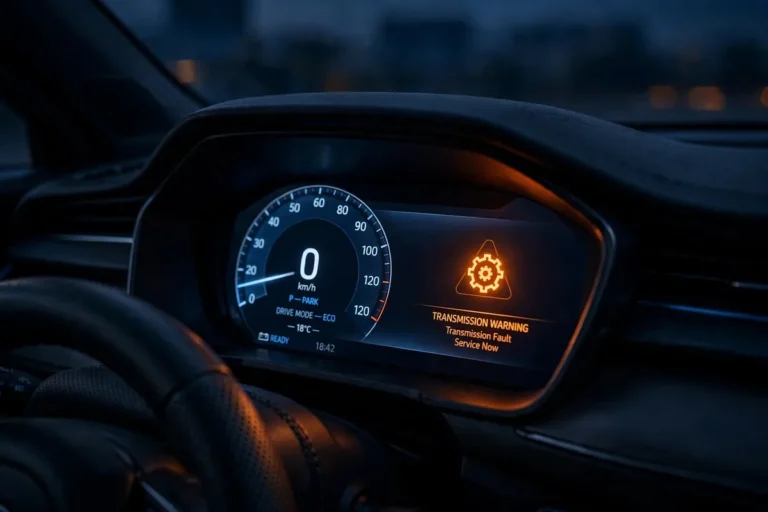
- The transmission warning light coming on after a long or slow drive, sometimes going out again after the car rests. That pattern points strongly at temperature.
- Gear changes that get worse as the drive goes on — smooth when the car is cold in the morning, harsh, delayed or jerky once everything is hot.
- Slipping — the engine revs rise but the car does not pick up speed the way it should, especially pulling away in traffic.
- A burnt smell from the fluid. Healthy fluid is red and clean; dark fluid with a burnt smell has been overheated and is no longer protecting anything.
- Limp mode on hot days — the car locking itself into one gear to protect itself. It is not a fault in itself; it is the car telling you something else is wrong.
If you are seeing the warning light itself, our guide to the transmission warning light explains the causes and what to do in the first ten minutes.
How To Protect Your Gearbox Through a Dubai Summer
None of this requires special equipment or expensive add-ons. It comes down to a few habits:
- Do not skip fluid changes. This is the big one. Fresh fluid handles heat; old fluid gives up. Gearbox fluid ages faster here than the service schedules written for cooler countries assume, which is why a fluid service is the single best thing you can do for a gearbox in Dubai — our service pages set out the interval we work to.
- Let a gap open in traffic. Instead of creeping metre by metre on the throttle, wait, then move in one clean go. Your clutches will thank you.
- Take a warning light seriously the first time. A light that appears on a hot day and disappears overnight has not fixed itself — the fault code is still stored, and a diagnostic scan will still find it while the fix is small.
- Get the fluid checked after a hard summer. If your car towed, crawled through months of traffic, or showed any of the signs above, a fluid inspection is a cheap precaution next to the cost of the repair it can prevent.
- Do not ignore a small leak. Low fluid overheats faster, and overheated fluid wears everything it touches. A leak that looks minor on your parking space matters more in August than it would in January.
Frequently Asked Questions
Does Dubai heat really damage transmissions?
Yes. Gearboxes rely on fluid to change gears, lubricate parts and carry heat away. In sustained summer heat the fluid breaks down faster, seals harden, and small faults grow quickly — which is why we see more serious gearbox failures at the end of summer than at any other time of year.
What are the first signs of an overheating transmission?
A warning light that comes on after long or slow drives, gear changes that feel fine when the car is cold but harsh or delayed when hot, slipping under acceleration, and dark fluid with a burnt smell. Any one of these is worth a diagnostic check.
How often should transmission fluid be changed in Dubai?
More often than the schedules written for cooler climates suggest — fluid ages faster in this heat. Follow the interval set out on our service pages for your gearbox type, and if you do not know when yours was last changed, treat that as your answer: get it inspected.
My warning light came on in summer but went off again. Is it fine now?
Not necessarily. Heat-related faults often disappear when the car cools down, but the fault code stays stored in the car’s computer and the fluid may already be burnt. A scan and a fluid check will tell you honestly whether anything needs doing.
Related services: transmission diagnostics in Dubai, automatic transmission repair, CVT transmission repair, and our complete guide to car transmission and gearbox repair in Dubai.
Worried Summer Has Taken a Toll on Your Gearbox?
A fluid check and a diagnostic scan now cost a fraction of the rebuild they can prevent. Our team at Falak Al Ebdaa in Ras Al Khor Industrial Area 2 has been repairing gearboxes for over 30 years, we work on all car brands with genuine parts, and our work is covered by warranty.
Call or WhatsApp us on +971 50 124 4337 — Sat to Thu, 7am–1pm and 3pm–8pm (Friday closed) — or request a free quote through the site and we will call you back.
Seeing Any of These Signs?
Don’t wait for a small fault to become a breakdown. Bring your car to Falak Al Ebdaa Transmission in Ras Al Khor Industrial Area 2 for a free diagnostic inspection – honest advice, a clear price, and no obligation. We’re open Saturday to Thursday, 7:00 AM-1:00 PM and 3:00-8:00 PM.